Tides
Rule of Twelfths Explained (with Worked Examples)
Published · Last checked October 2026
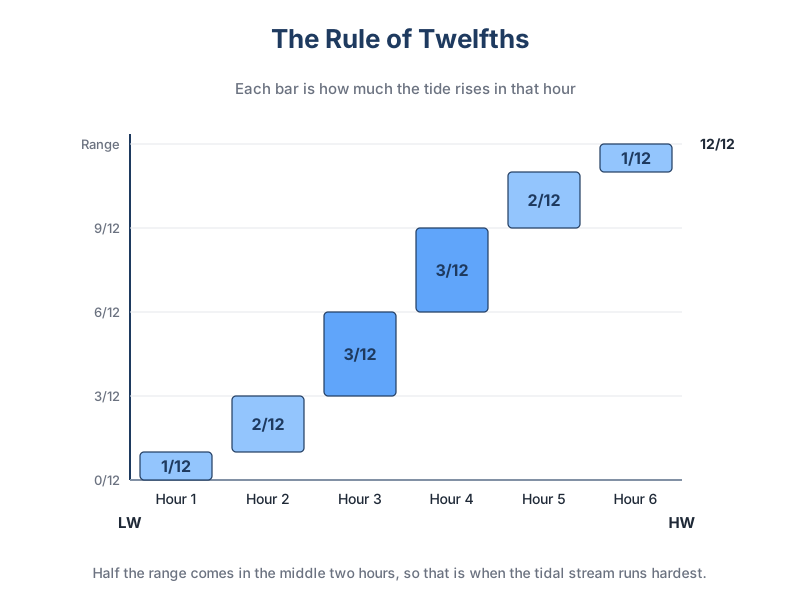
The rule of twelfths is a quick way to estimate the height of tide between low and high water. Divide the range by 12. In the first hour the tide rises 1 twelfth, then 2, 3, 3, 2 and 1 twelfths in the following hours, so after three hours it has risen half the range. It assumes a smooth 6-hour tide, so it is an estimate, not a substitute for the port's tidal curve.
| Hour | Twelfths that hour | Total so far |
|---|---|---|
| 1st | 1/12 | 1/12 |
| 2nd | 2/12 | 3/12 (a quarter) |
| 3rd | 3/12 | 6/12 (half) |
| 4th | 3/12 | 9/12 (three quarters) |
| 5th | 2/12 | 11/12 |
| 6th | 1/12 | 12/12 |
Worked example
Low water is 0.8 m at 06:00 and high water is 5.6 m at 12:00. The range is 4.8 m, so one twelfth is 0.4 m.
- At 07:00: 0.8 + 1 × 0.4 = 1.2 m
- At 08:00: 0.8 + 3 × 0.4 = 2.0 m
- At 09:00: 0.8 + 6 × 0.4 = 3.2 m (half tide)
- At 10:00: 0.8 + 9 × 0.4 = 4.4 m
Going the other way, you can answer the question every skipper asks: when will there be enough water? If you need 2.5 m of tide to cross a bar, you need 1.7 m of rise, about 4¼ twelfths. By 08:00 it has risen 3 twelfths and the third hour adds 3 more, so you need about 1¼ of those: roughly 25 minutes into the third hour, around 08:25.
When the rule of twelfths goes wrong
- Tides that are not 6 hours. Divide the actual duration into six equal 'tidal hours' instead.
- Odd-shaped tides. The Solent's double high waters, and places with a long stand, do not follow a smooth curve. Use the curve in the almanac.
- Weather. Strong winds and low pressure can raise the level; high pressure lowers it.
Try it with our rule of twelfths calculator.
Worked examples
- Height of tide at a given time
- Time the tide reaches a height
- Under-keel clearance
- Crossing a drying height