Exam guide
RYA Theory Exam Pass Mark — How It's Graded
Published · Last checked October 2026
The RYA does not publish a percentage pass mark for its Day Skipper or Coastal Skipper/Yachtmaster Offshore theory exams. Most papers are graded rather than scored: an RYA instructor marks each paper (or each chartwork question) on a scale, and you pass if your work is “Average” or better, meaning no significant errors of principle. Some training centres do publish a numeric mark for the collision regulations paper, but they disagree on the figure (we found both 60% and 80/100), so ask your own centre.
Why there is no single number
The RYA’s official course pages describe course length (about 40 hours plus exam time for each theory course) and delivery options, but not the marking scheme. That detail reaches students through RYA training centres, and their published guidance varies. Where we quote a figure below, it comes from a training centre, not the RYA itself.
How the Day Skipper theory exam is graded
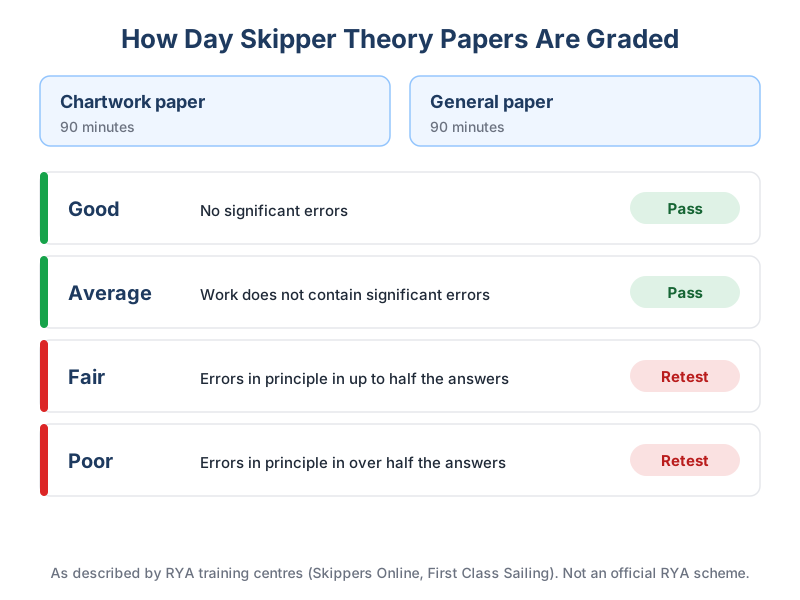
Training centres describe two papers: a chartwork paper and a general paper. Skippers Online allows 90 minutes for each. Rather than a percentage, papers receive grades. First Class Sailing describes four:
| Grade | Meaning | Result |
|---|---|---|
| Good | No significant errors | Pass |
| Average | Work does not contain significant errors | Pass |
| Fair | Errors in principle in up to half of the answers | Retest |
| Poor | Errors in principle in over half of the answers | Retest |
Cambridge University Yacht Club uses a six-step scale (Excellent, Very Good, Good, Average, Fair, Poor) and states that each chartwork question, as well as the general paper, must be graded Average or above. The principle is the same: show you understand the method, and minor slips will not fail you.
Chartwork carries the most weight, so practise position fixing, course to steer with tidal streams and tidal heights until they are automatic. Our rule of twelfths calculator is handy for checking your working, and the Day Skipper practice exam tests the whole syllabus.
Coastal Skipper / Yachtmaster Offshore theory exam
This is where published guidance diverges most. Two RYA training centres describe different paper structures and marks:
| Cambridge University Yacht Club | Skippers Online | |
|---|---|---|
| Papers | Chartwork, Meteorology, Collision Regulations (IRPCS), plus the Day Skipper general paper if needed | Chartwork (2 h), IRPCS (90 min), Passage Making Part A (90 min), Passage Making Part B (2 h) |
| IRPCS pass mark | 80/100 | 60% |
| Chartwork | Graded; Average or above on every question | Graded; show a reasonable grasp of the topic |
| Other papers | Meteorology graded; Average or above | Passage Making papers: 60% |
We could not find an RYA page that settles the difference, so we are not quoting one “official” number. If you are taking this course, your centre will tell you exactly which papers you sit and how each is marked. Either way, the collision regulations are worth knowing very well: work through COLREGS and traffic separation and test yourself with the lights, shapes and sound signals quiz. The Coastal Skipper course, Coastal Skipper study notes and practice exam cover the rest.
Rules that most centres share
Limited open book
Skippers Online allows only the RYA training almanac and training charts, not course notes or the handbook. Each paper must be completed in one sitting within the time limit.
Resits are normal
If a paper falls short you get feedback, study the weak area and resit under exam conditions, usually with different questions. Cambridge University Yacht Club says you may retake as many times as you like, with a small admin fee outside course dates. A marginal result can sometimes be cleared by answering one or more extra questions.
Theory certificates are not the Yachtmaster
Passing the shorebased theory gives you a course completion certificate. The Yachtmaster Coastal and Offshore certificates of competence come from a separate practical exam with an independent examiner. See how long Yachtmaster takes for those requirements.
What about Yachtmaster Ocean?
The RYA states that the Yachtmaster Ocean exam is an oral and written assessment of sights you took at sea, lasting about 1.5 to 2 hours. Holding the Yachtmaster Ocean shorebased course completion certificate exempts you from the written part. Prepare with the Yachtmaster Ocean course, sextant corrections and nautical almanac tables, then try the Yachtmaster Ocean practice exam.
A note on our practice exams
The practice exams on learntosail use a percentage score so you can track progress. That score is our own and does not predict an RYA grade. Use it to find weak topics, then go back to the lessons.