Tides
Secondary Port Tidal Calculations — How to Work Them Out
Published · Last checked October 2026
Tide tables give full predictions only for standard ports. For a secondary port you start from the nearest standard port's times and heights, then apply the time and height differences printed in the almanac, interpolating when the standard port's times and heights fall between the tabulated values. You then use the standard port's tidal curve to find the height at any time.
The method
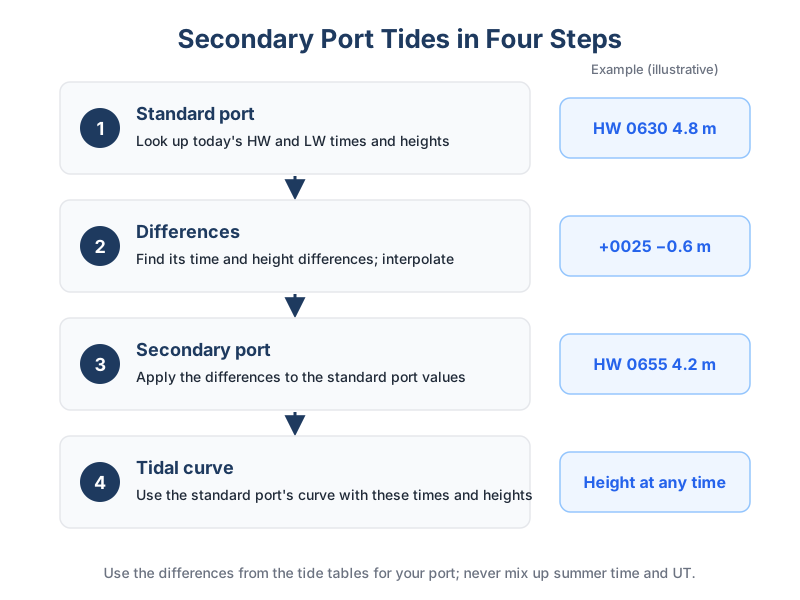
- Look up the standard port's HW and LW times and heights for the day.
- Find the secondary port's entry. It gives time differences for HW and LW (for two standard-port HW times, e.g. 0000 and 0600) and height differences for MHWS, MHWN, MLWN and MLWS.
- Interpolate the time differences for your actual standard-port times. If HW is at 0300 and the differences are −0020 at 0000 and −0040 at 0600, use −0030.
- Interpolate the height differences the same way, using the day's standard-port heights against the mean spring and neap heights.
- Apply the differences to get the secondary port's HW and LW times and heights.
- Convert to local time if needed, then use the standard port's curve with the secondary port's heights to find the height at your chosen time.
Why the differences vary
The tide wave arrives at different places at different times and its height changes as it travels into bays and estuaries. Time differences can also change with springs and neaps, which is why they are tabulated for two standard-port times.
Practise the whole process in the tidal heights lesson, then check yourself in the Day Skipper practice exam.