Lights
Light Characteristics on Charts — Fl, Oc, Iso, Q Explained
Published · Last checked October 2026
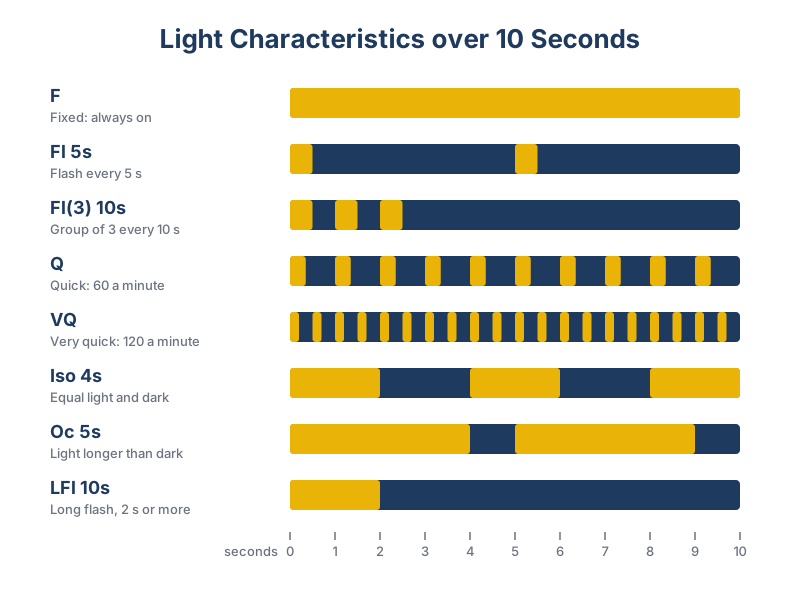
A light's characteristic tells you its rhythm, colour, period, height and range. For example Fl(3)WR.15s25m18/14M means: group of 3 flashes, white and red sectors, repeating every 15 seconds, 25 m above mean high water springs, visible 18 miles (white) and 14 miles (red). At night you identify a light by timing its period with a stopwatch.
| Abbreviation | Name | What you see |
|---|---|---|
| F | Fixed | A steady light |
| Fl | Flashing | Light shorter than dark |
| Fl(3) | Group flashing | Groups of 3 flashes |
| LFl | Long flashing | Flash of at least 2 seconds |
| Oc | Occulting | Light longer than dark; eclipses |
| Iso | Isophase | Equal light and dark |
| Q | Quick | 50 to 60 flashes a minute |
| VQ | Very quick | 100 to 120 flashes a minute |
| Al.WR | Alternating | Changes colour, e.g. white then red |
| Mo(A) | Morse code | Dot-dash: the letter A |
The rest of the description
- Colour: W white (often omitted), R red, G green, Y yellow, Bu blue.
- Period: the time for one full cycle, e.g. 10s.
- Height: in metres above mean high water springs.
- Range: nominal range in nautical miles (M). A light may be seen further on a clear night, but also may dip below the horizon before its range if you are low down.
- Sectors: some lights show different colours over different arcs, drawn on the chart. A white sector often marks the safe channel between red and green.
- Dir: a directional light shows a narrow beam along a channel.
Identifying a light at night
Count the flashes and time the full period, from the start of one group to the start of the next. Compare with the chart. Cardinal buoys follow a clock face: continuous for north, 3 for east, 6 plus a long flash for south and 9 for west. Practise with the lights at night drill.
Related guides
Frequently asked questions
What does 'M' mean after a light?
Nautical miles of nominal range: how far the light can be seen in clear weather, ignoring the curvature of the earth.
What is the difference between flashing and occulting?
Flashing lights are on for less time than they are off. Occulting lights are on for longer than they are off, so they look like a steady light with brief eclipses.