COLREGs Rule 3
What Does Restricted in Ability to Manoeuvre Mean?
Published · Last checked October 2026
A vessel restricted in its ability to manoeuvre (RAM) is one that, because of the nature of its work, cannot keep out of the way of other vessels as the rules require. Examples include dredgers, cable layers, vessels servicing buoys, launching aircraft or towing in a way that limits their course. They show red-white-red all-round lights at night and ball-diamond-ball shapes by day, and both power and sailing vessels must keep clear of them.
The definition
Rule 3(g) defines a vessel restricted in her ability to manoeuvre as one which from the nature of her work is restricted in her ability to manoeuvre as required by the rules and is therefore unable to keep out of the way of another vessel. The key idea is the work: the vessel is fully working, but its job ties it to a course or position.
- Laying, servicing or picking up a navigation mark, submarine cable or pipeline
- Dredging, surveying or underwater operations
- Replenishment or transferring people, stores or cargo while under way
- Launching or recovering aircraft
- Mine clearance operations
- A towing operation that severely restricts the tow from deviating from its course
Contrast this with not under command (NUC), where something has gone wrong, such as engine or steering failure. A NUC vessel shows two all-round reds and two balls.
Lights and shapes (Rule 27)
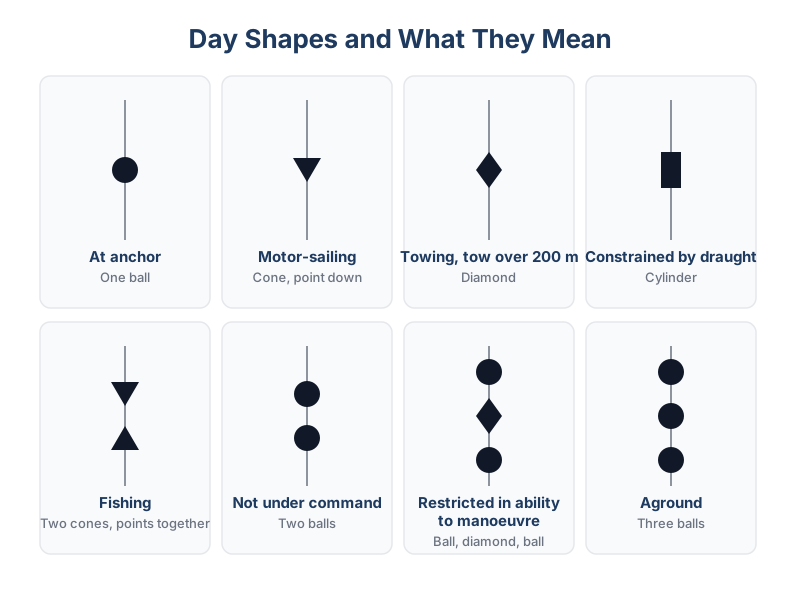
| Situation | Night | Day |
|---|---|---|
| RAM, stopped | Red, white, red all-round in a vertical line | Ball, diamond, ball |
| RAM, making way | As above plus masthead light(s), sidelights and sternlight | Ball, diamond, ball |
| RAM at anchor | As above plus anchor light(s) | Ball, diamond, ball |
| Dredging with obstruction | Two all-round reds on the obstructed side, two greens on the side to pass | Two balls obstructed side, two diamonds passing side |
A vessel engaged in diving operations that is too small to show the full shapes shows a rigid replica of International Code flag A instead.
A memory aid many sailors use for red-white-red is 'Red, White, Red: restricted ahead.'
Who keeps clear
Under Rule 18, a power-driven vessel, a sailing vessel and a vessel engaged in fishing must all keep out of the way of a RAM vessel. Only a vessel not under command is equal to it in the hierarchy. On a yacht, treat RAM vessels as fixed obstructions: give them a generous berth and pass on the side indicated if they show the dredging signals.
Do not cut between a tug and its tow, or between a survey vessel and its towed gear. Cables and sensors may trail well astern and not be visible.
Learn the full set of lights in the navigation lights guide and the COLREGs rules and lights lesson.