COLREGs Rule 28
What Is a Vessel Constrained by Her Draught? (CBD)
Published · Last checked October 2026
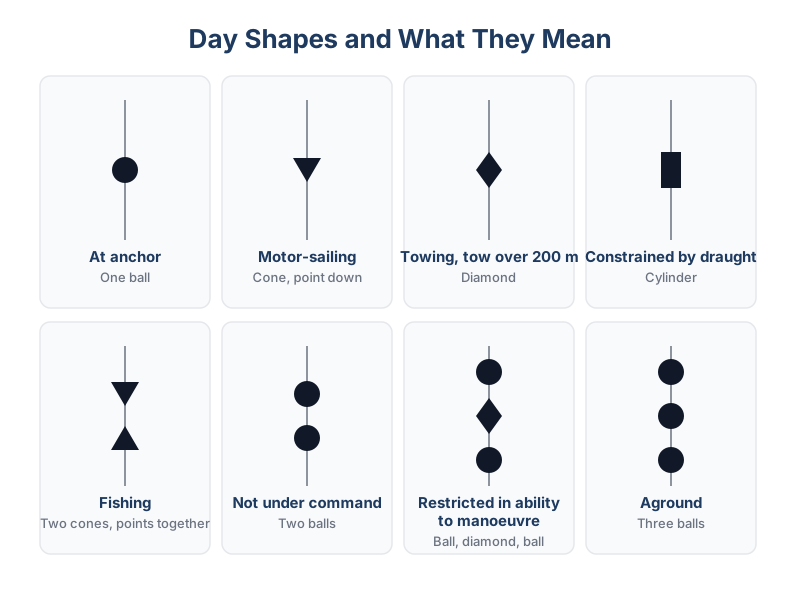
A vessel constrained by her draught (CBD) is a power-driven vessel that, because of its draught relative to the available depth and width of water, is severely restricted in its ability to deviate from its course. It may show three all-round red lights in a vertical line at night or a black cylinder by day. Other vessels, including sailing yachts and fishing vessels, must if circumstances allow avoid impeding its safe passage.
The definition
Rule 3(h) defines a vessel constrained by her draught as a power-driven vessel which, because of her draught in relation to the available depth and width of navigable water, is severely restricted in her ability to deviate from the course she is following. In practice it means a deep-laden tanker, bulk carrier or large container ship following a dredged channel or deep-water route.
Only power-driven vessels can be CBD, and showing the signals is optional: Rule 28 says such a vessel may exhibit them.
Lights and shape
| Time | Signal | Shown with |
|---|---|---|
| Night | Three all-round red lights in a vertical line | Normal power-driven vessel lights |
| Day | A black cylinder | Where it can best be seen |
Do not confuse three reds (CBD) with two reds (not under command) or red-white-red (restricted in ability to manoeuvre).
'Not impede' is not 'give way'
Rule 18(d) says any vessel other than one not under command or restricted in its ability to manoeuvre shall, if the circumstances of the case admit, avoid impeding the safe passage of a vessel constrained by her draught. This duty applies early, before any risk of collision arises. You should act so a close-quarters situation never develops.
- Keep out of the deep-water channel when a CBD vessel is approaching.
- Cross the channel quickly and at right angles, well ahead or well astern.
- Do not assume the ship can slow quickly: a laden tanker may need a mile or more to stop.
- Remember the ship's wash and the blind zone ahead of its bow, which can extend a long way.
The CBD vessel itself must still navigate with particular caution, having full regard to its special condition.
Where yachts meet CBD vessels in the UK
You are most likely to see these ships in approaches such as Southampton Water, the Thames Estuary, Milford Haven and the Humber, and in traffic separation schemes such as the Dover Strait. Local harbour byelaws often add rules, such as a moving prohibited zone around large ships in Southampton Water. Check the harbour authority's guidance before you sail.
See also the narrow channel rule guide and the traffic and COLREGs lesson.