Chartwork
How to Plot a Bearing on a Chart — Step by Step
Published · Last checked October 2026
To plot a bearing on a chart, take the compass bearing of a charted object, correct it for deviation and variation to get a true bearing, then set your plotter to that bearing and line its edge up on the object. Draw the line from the object out to sea, roughly where you think you are. You are somewhere on that line. Two or three such lines crossing give you a fix.
What you need
- A chart of the area and a soft pencil (2B) with an eraser.
- A Breton-style plotter or parallel rule.
- A hand-bearing compass, or the steering compass if the object is ahead.
- The variation from the chart's compass rose, and your deviation card if using the steering compass.
Step by step
- Pick a good object: charted, unmistakable and fairly close, such as a lighthouse, church spire or headland.
- Take the bearing and note the time and log reading.
- Convert to true. A hand-bearing compass used away from steel has negligible deviation, so just apply variation: going from magnetic to true, subtract westerly variation and add easterly. Remember 'Variation West, Magnetic Best; Variation East, Magnetic Least'.
- Set the plotter to the true bearing, aligning its grid with the chart's meridians or parallels.
- Line up the edge of the plotter on the object, with the direction arrow pointing from you towards the object.
- Draw the position line in the area where you think you are, not all the way across the chart.
- Label it with the time and an arrowhead at the end pointing to the object.
| Variation | Rule | Example |
|---|---|---|
| 2° W | Subtract | 065°M becomes 063°T |
| 2° E | Add | 065°M becomes 067°T |
Turning bearings into a fix
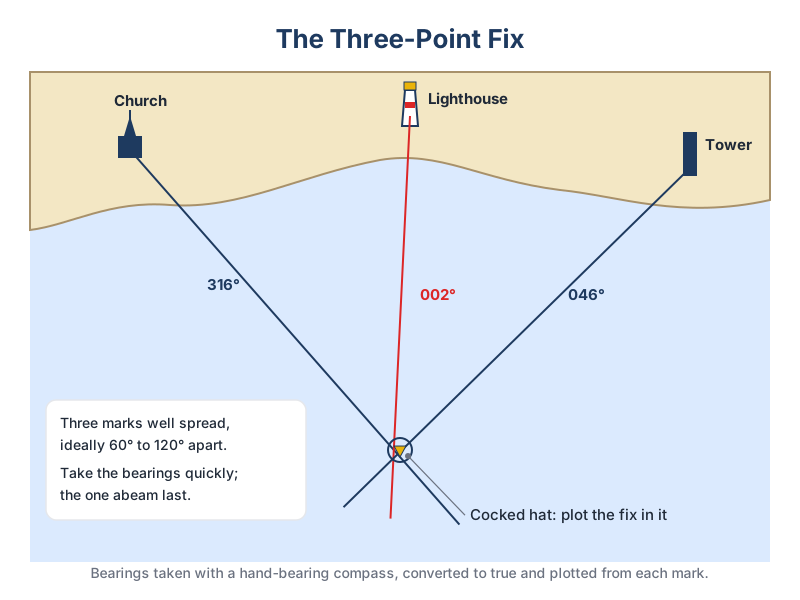
One bearing tells you only that you are somewhere on a line. Take a second and third bearing quickly, of objects ideally 60 to 120 degrees apart, and plot them the same way. Where they cross is your fix. Three lines rarely meet at a point: the small triangle they form, the 'cocked hat', shows the accuracy. See the three-point fix guide.
Practise in the position fixing lesson.