Basics
What Colour Is Port and Starboard? Red, Green and Why
Published · Last checked October 2026
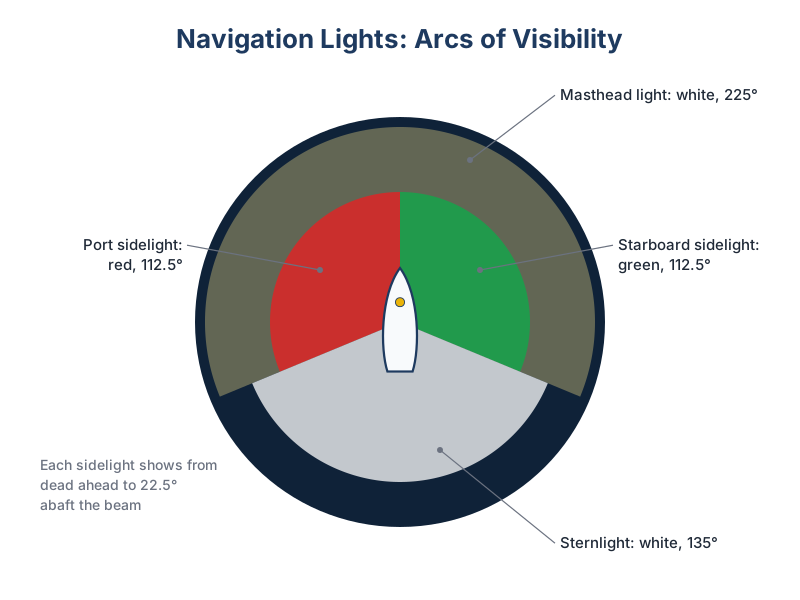
Port, the left side of a boat facing forward, is red. Starboard, the right side, is green. Every vessel under way at night shows a red sidelight to port and a green sidelight to starboard. In IALA Region A, which includes the UK and Europe, port hand buoys are red and starboard hand buoys are green. In Region B, used in the Americas, the buoy colours are reversed, but navigation lights are the same everywhere.
Memory aids
- Port wine is red. Port and red are both short words; starboard and green are both longer.
- 'There's no red port left in the bottle.' Port is left and red.
- Port has four letters, as does left.
Where the colours appear
| Where | Port | Starboard | Notes |
|---|---|---|---|
| Sidelights on vessels | Red | Green | Each shines from dead ahead to 22.5° abaft the beam (112.5°) |
| Lateral buoys, Region A | Red can | Green cone | Applies going with the direction of buoyage |
| Lateral buoys, Region B | Green can | Red cone | Americas, Japan, Korea, Philippines |
| Harbour entrance lights | Usually red | Usually green | Follows the local buoyage region |
Why it matters for collision avoidance
The colours let you work out what another vessel is doing at night. If you see a red light only, you are looking at her port side and she is crossing from your right towards your left or heading away to your right. If you see green only, you see her starboard side. Both red and green together mean she is pointing straight at you. Under the right of way rules, a power-driven vessel that sees another's red light on her own starboard side is normally the give-way vessel in a crossing situation.
Why 'port' and 'starboard'?
'Starboard' comes from the old steering board, an oar mounted on the right side of early ships. Because the steering oar was on the right, ships tied up with their left side against the quay, so that side became the 'port' side. The older word 'larboard' was dropped because it sounded too much like starboard when shouted.
Learn the full set of lights in the navigation lights guide and the COLREGs lights lesson.
Other places you meet port and starboard
- Sailing rules: a boat on starboard tack, with the wind coming over her starboard side, has right of way over one on port tack.
- Marinas: you may be told to berth 'port side to', meaning your left side against the pontoon. Rig fenders and lines on that side.
- Harbour entrances: lights on the pierheads usually follow the local buoyage, so in the UK the light on your port side going in is often red.
- Dinghies and small craft: small boats under oars may show only a white light, so colour clues are not always there.
Use port and starboard rather than left and right aboard. They do not change when someone turns round, which avoids confusion in an emergency.