Buoyage
What Is a Lateral Mark? Port and Starboard Buoys Explained
Published · Last checked October 2026
A lateral mark shows the sides of a channel. In IALA Region A, which covers the UK and Europe, port hand marks are red cans and starboard hand marks are green cones. You keep red to port and green to starboard when travelling in the direction of buoyage, which normally means heading into harbour from seaward. At night port marks show a red light and starboard marks a green light, in any rhythm except a few reserved ones.
Port and starboard hand marks
Lateral marks are the commonest buoys you will see around the UK coast. They line the edges of dredged channels, river entrances and harbour approaches. What matters is not the buoy itself but which side of it you pass.
| Feature | Port hand mark | Starboard hand mark |
|---|---|---|
| Colour | Red | Green |
| Shape | Can (flat top), pillar or spar | Cone (pointed), pillar or spar |
| Topmark (if fitted) | Single red can | Single green cone, point up |
| Light (if fitted) | Red, any rhythm | Green, any rhythm |
| Pass it | On your port side going with the buoyage | On your starboard side going with the buoyage |
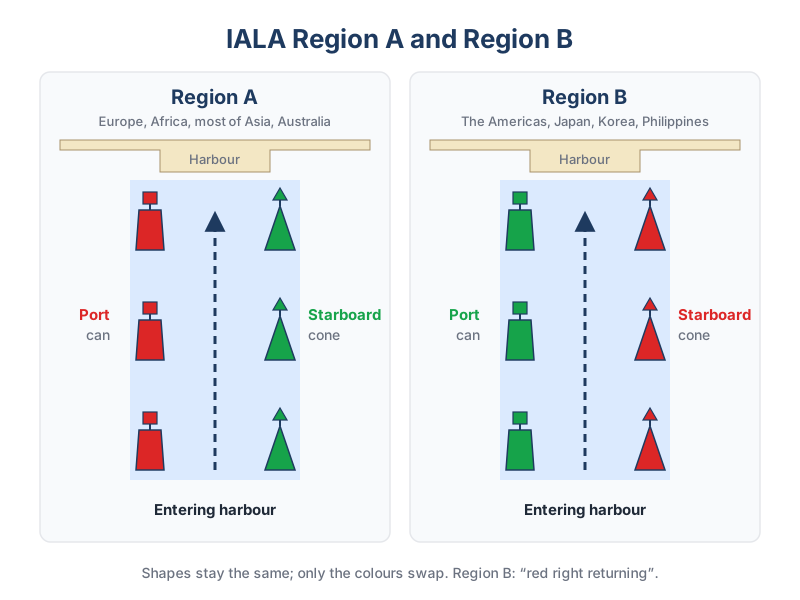
The direction of buoyage
Lateral marks only make sense once you know which way is 'with' the buoyage. The rule is simple:
- Approaching a harbour, river or estuary from seaward: you are going with the buoyage, so leave red to port and green to starboard.
- Leaving harbour: you are going against the buoyage, so leave red to starboard and green to port.
- Along the coast: the general direction is set by the authorities and shown on charts with a magenta arrow symbol. Check the chart rather than guessing.
Most lateral buoys are numbered, with even numbers on port marks and odd numbers on starboard marks, counting up as you head in. That helps you tick them off against the chart.
Lights and identification at night
A port mark shows a red light and a starboard mark a green light. The rhythm can be anything that does not clash with other marks, so you will see Fl R 3s, Q G, Fl(2) R 5s and so on. The composite group Fl(2+1) is reserved for preferred channel marks. Read the full characteristic on the chart and time it with a watch to confirm which buoy you are looking at. See light characteristics for how the abbreviations work.
Common mistakes
- Forgetting to flip the rule when leaving harbour.
- Cutting a corner between buoys: they mark the edge of deep water, not the middle of a big safe area.
- Assuming a lateral mark sits exactly on the channel edge. Buoys swing on their moorings and can drag.
Work through the full system in the buoyage and lights lesson.
Lateral marks on the chart
On an Admiralty chart, lateral buoys are drawn as small can or cone symbols tinted red or green, with the light characteristic and number printed beside them, for example 'Fl R 4s No 6'. Beacons, which are fixed posts rather than floating buoys, use the same colours and topmarks and are common on rivers and drying harbours. Because a beacon stands on the bottom, it often marks the very edge of a bank, so give it a little more room than its floating cousin. Before entering an unfamiliar harbour, list the marks in order with their characteristics, so you can tick each one off as it passes and notice straight away if one is missing or out of place.
Small-craft channels in rivers are sometimes marked with simple withies or posts that do not follow the IALA system closely. The local pilot book or harbour guide will explain them.