Berthing
What Is Med Mooring? Stern-To Berthing Explained
Published · Last checked October 2026
Med mooring is berthing at right angles to a quay, usually stern-to, with the stern held by two lines ashore and the bow held off by your own anchor or a laid 'lazy line'. It packs many boats into a small harbour and is common across the Mediterranean and increasingly elsewhere. The skill is reversing in a straight line while laying anchor or picking up the lazy line, then tensioning the bow so the stern stays clear of the quay.
How it works
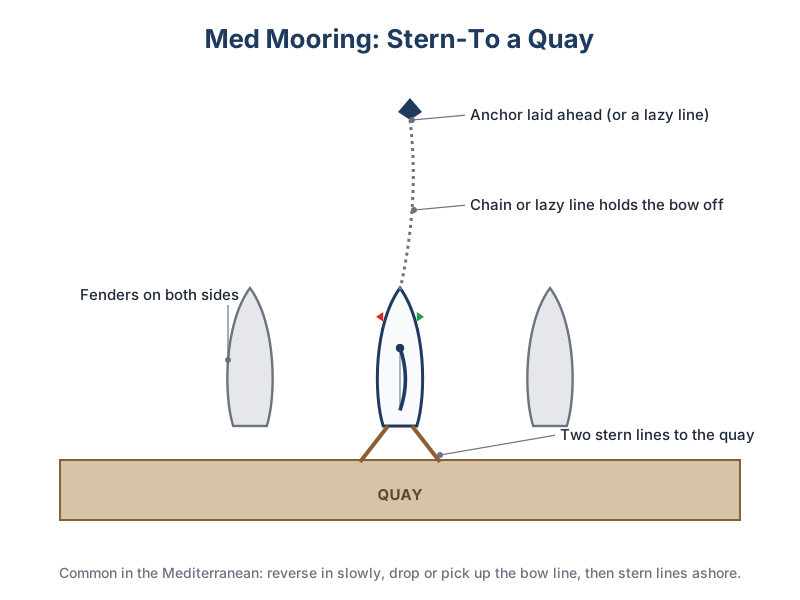
Instead of lying alongside, each boat backs in between neighbours. Two stern lines, often crossed, go to rings or bollards on the quay. Forward, either the boat's own anchor, dropped several boat lengths out, or a 'lazy line' attached to a heavy ground chain holds the bow and keeps the stern off the wall. Fenders go on both sides because you will be touching neighbours.
Stern-to with a lazy line
- Rig fenders both sides, prepare two stern lines and a boathook, and pick your gap.
- Practise reversing in open water first to learn the prop walk direction.
- Line up and reverse slowly. Allow for prop walk and crosswind.
- Pass or throw the stern lines to a marinero or a crew member stepping ashore.
- Pick up the lazy line from the quay with a boathook, walk it forward along the side deck, and haul it tight to a bow cleat.
- Tension the stern lines so the boat sits a step's distance off the quay, then rig the passerelle.
Stern-to with your own anchor
Drop the anchor around three to four boat lengths out from the quay, ideally more, on a line straight to your gap, then reverse in, paying out chain steadily. When the stern lines are on, take up the chain to hold the stern off. Know where neighbours' anchors lie, because crossing them is the classic cause of tangles on departure.
| Lazy line | Own anchor | |
|---|---|---|
| Where | Marinas and many town quays | Town quays without lines, remote harbours |
| Pros | Quick, secure, no crossed anchors | Works anywhere with a quay |
| Cons | Slimy line, risk to propeller | Crossed anchors, needs good depth and holding |
Common mistakes
- Letting the lazy line sink near the propeller while going astern.
- Dropping the anchor too close to the quay, so it never digs in.
- Coming in too fast. Slow is in control.
- Leaving the bow line slack, so the stern hits the quay in a gust.
See how to anchor a yacht and the berthing lesson for the skills behind it.