Tidal sums
How to Calculate Clearance Under a Bridge When Sailing
Published · Last checked October 2026
To calculate clearance under a bridge, take the charted vertical clearance, which on modern ADMIRALTY charts is usually above Highest Astronomical Tide (HAT), and add the difference between HAT and the height of tide at the time you pass. Then subtract your air draught, the height from the waterline to the top of the mast including aerials and the masthead light. If the answer is not comfortably positive, wait or do not go.
Know your air draught
Air draught is the height from the waterline to the highest point of the boat: usually the VHF aerial or wind instrument at the masthead. Measure it, or get it from the builder, and write it near the chart table. Remember that a heavily laden boat sits lower and gains a little air draught margin, while a light one floats higher.
Find the reference level
Vertical clearances are not measured from chart datum. Modern UK charts give them above HAT; older charts and some foreign or inland charts use MHWS. Check the chart's notes or title block. Because the tide is almost always below HAT, the actual clearance is usually greater than charted.
The calculation
- Charted clearance (above HAT or MHWS).
- Find the HAT or MHWS height above chart datum for the nearest port (in the almanac or on the chart).
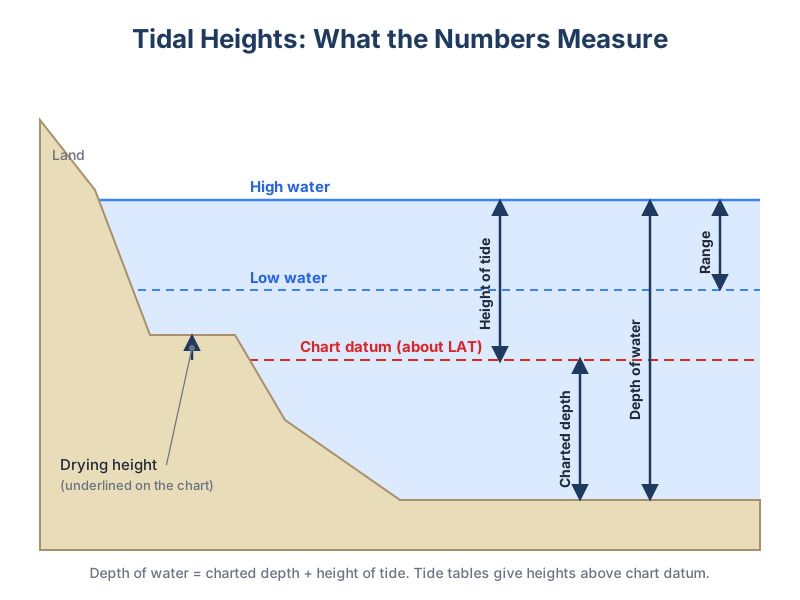
- Find the height of tide when you will pass.
- Extra clearance = HAT (or MHWS) − height of tide.
- Actual clearance = charted clearance + extra clearance.
- Margin = actual clearance − air draught. Want at least a metre or so, more in any swell or wash.
| Item | Value |
|---|---|
| Charted clearance above HAT | 12.0 m |
| HAT above chart datum | 5.8 m |
| Height of tide at time of passing | 3.4 m |
| Extra clearance (5.8 − 3.4) | 2.4 m |
| Actual clearance (12.0 + 2.4) | 14.4 m |
| Air draught | 13.2 m |
| Margin | 1.2 m |
Practical checks
- Many bridges have clearance gauge boards showing the current headroom. Trust the board over your sums if they disagree.
- Overhead power cables need extra margin: electricity can arc across a gap, so add the safe clearance stated on the chart or by the owner.
- For headroom, a falling tide is kinder: clearance increases while you wait. On a rising tide it shrinks, so check depth below as well as height above.
- Pass slowly, square on, with nobody at the mast.
Brush up on heights of tide and the tidal heights lesson.