Ropework
Rolling Hitch Uses — Clearing Riding Turns and More
Published · Last checked October 2026
A rolling hitch grips a rope, spar or rail and resists sliding along it in one direction. Its main use on a yacht is to clear a riding turn on a winch: tie a second line onto the jammed sheet with a rolling hitch, take that line to another winch, and winch it in to take the load so the riding turn can be freed. It is also used to take strain off an anchor chain or mooring line and to hold a line to a stanchion.
Main uses aboard
- Clearing a riding turn: when a sheet jams on a winch because a turn has crossed over itself, a rolling hitch lets you take the load elsewhere.
- Taking the strain off a line so you can re-lead it, change a block or move it to another winch.
- Anchor snubber: a line tied to the chain with a rolling hitch takes the load off the windlass and reduces snatching (a chain hook is more common today).
- Gripping a spar or rail: hanging a fender board, or securing a line to a stanchion so it will not slide along under a sideways pull.
- Securing a flag halyard or burgee stick, where the pull is along the pole.
How to tie it
- Decide which way the load pulls along the rope or spar.
- Take the working end round the spar or rope, crossing over the standing part towards the load.
- Take a second turn in the same direction, riding over the first, still working towards the load.
- Take a third turn on the other side of the standing part, away from the load, and tuck it under itself as a hitch.
- Slide it snug and pull the line in the direction of the load. The two riding turns should bite and hold.
The most common mistake is putting the two turns on the wrong side. The doubled turns must be on the side the load comes from, or the hitch will slide straight along.
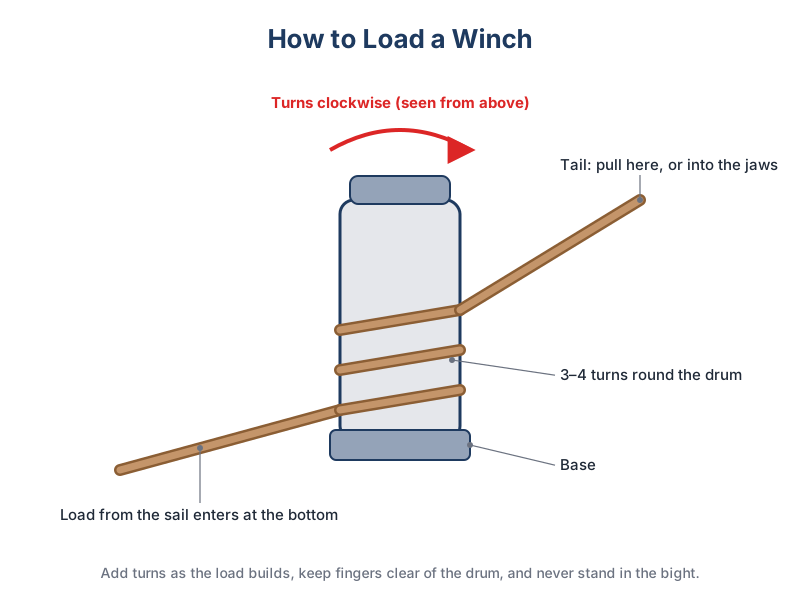
Clearing a riding turn step by step
- Ease the load on the sail if possible by steering to reduce the pull (for a jib sheet, bear away or luff slightly).
- Tie a spare line onto the loaded part of the sheet, ahead of the winch, with a rolling hitch.
- Lead the spare line to a free winch or cleat, keeping it fair, and winch it in until it takes the load.
- The jammed sheet is now slack between the hitch and the winch: unwind it and remove the riding turn.
- Rewind the sheet correctly, take the load back on it and remove the rolling hitch line.
| Hitch | Grip | Notes |
|---|---|---|
| Rolling hitch | Good, one direction | Standard sailing knot |
| Clove hitch | Poor sideways | Slides along a rope |
| Icicle hitch | Excellent | Holds even on smooth tapered poles |
| Prusik | Good, both directions | Used in climbing; needs smaller line |
On RYA courses the rolling hitch is often taught together with winch handling, because clearing a riding turn is when you will need it most. It is worth rehearsing on the pontoon with a loaded sheet so the sequence is familiar before you face a jammed genoa sheet in a rising wind.
Practise it in the knots and ropework lesson and see the others in essential sailing knots.