Points of sail
What Is a Close Reach? Sailing Between Close-Hauled and Beam
Published · Last checked October 2026
A close reach is the point of sail between close-hauled and a beam reach: the wind comes from forward of the beam, roughly 50 to 80 degrees off the bow. The sails are eased a little from fully sheeted in, the boat heels less than when beating, and most yachts sail fast and comfortably. It is the point of sail you use to fetch a mark just upwind of you without tacking, and the angle many instructors teach for the final approach to a mooring or a man overboard.
Where the close reach sits
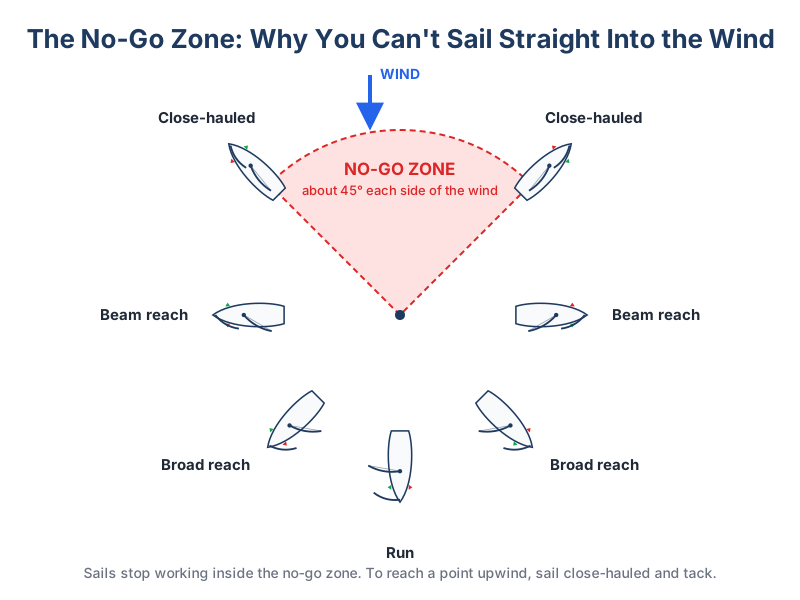
Picture the wind as twelve o'clock. Most cruising yachts cannot sail closer than about 40 to 45 degrees to the true wind: that wedge is the no-go zone. Just outside it you are close-hauled, with sails sheeted hard in. Bear away a further 10 to 30 degrees and you are on a close reach. Bear away until the wind is square on the side of the boat and you are on a beam reach. See points of sail explained for the full circle.
How to trim on a close reach
- Bear away from close-hauled to your new course.
- Ease the jib sheet until the windward telltales just stop lifting, then ease the mainsheet until the luff of the main just starts to back, and sheet in a touch.
- Move the jib car aft a little or ease the traveller down to open the leech and reduce heel.
- Check the helm: if the boat is pulling hard to windward, ease the main further.
| Close-hauled | Close reach | Beam reach | |
|---|---|---|---|
| Apparent wind angle | About 25 to 35 degrees | About 35 to 60 degrees | About 60 to 90 degrees |
| Sheets | Fully in | Eased slightly | Eased about halfway |
| Heel | Most | Moderate | Less |
| Typical speed | Slower | Fast | Often fastest |
Note the apparent wind angle on your instruments is narrower than the true wind angle, because the boat's own speed pulls the wind forward. Trim to the apparent wind, which is what the sails feel.
When to use a close reach
- Fetching a mark: if a headland or buoy lies a little upwind, a close reach may lay it in one board.
- Coming alongside or picking up a mooring: on a close reach you can spill wind by easing sheets to slow down, and sheet in to speed up.
- Man overboard recovery: the final approach of reach-tack-reach is usually a close reach so you can stop beside the casualty.
- Comfort: in a short sea a close reach is often a kinder angle than beating straight into the waves.
Practise the angles in the points of sail lesson.